


Ottoman Palace Cuisine Today: Mahmudiye, Sultan Kebab and the Pastry Plate
Ottoman palace cuisine developed on a line of its own, apart from the village kitchens of Anatolia. Ingredients arrived from every region the empire reached, so the cooking kept widening; at the same time, the order of the palace kitchen standardised it. The recipes we now call Ottoman took shape between those two forces: a broad map of ingredients and a disciplined technique.
Sweet and savoury on the same plate
This is the clearest marker of the style. Putting dried fruit, honey and spice next to meat was common in medieval European kitchens and was later abandoned; in Ottoman cooking it stayed. If you see lamb with plums or chicken with honey today, the recipe most likely descends from the palace line.
Mahmudiye
Chicken cooked with honey, almonds and dried apricot. The name is linked to Mahmud II. The recipe works like this: honey and apricot release their sugar as they cook, the almonds give up their oil, and the sauce thickens on its own — no flour, no cream. That is why the plate reads as rich without being heavy.
It appears on our menu as Mahmudiye with honey. We keep to the palace recipe and cook it without letting the sweetness take over.
Sultan Kebab
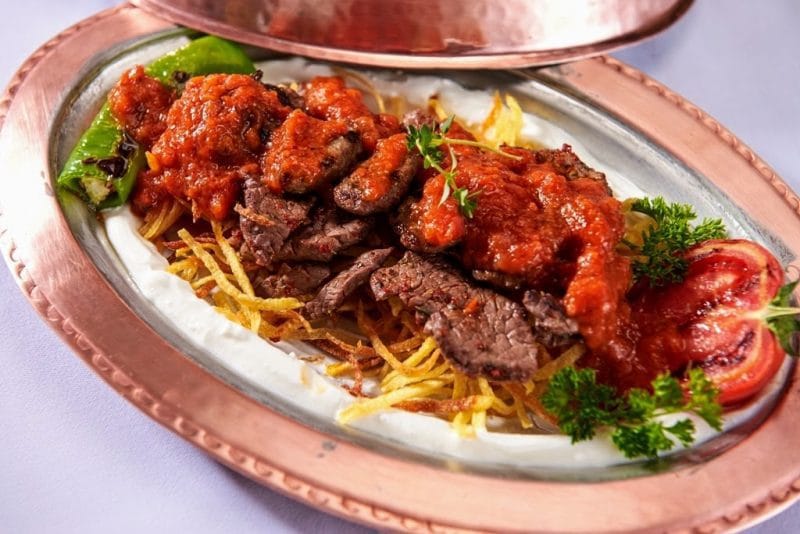
The word kebab now suggests skewers and grills, but in palace cooking it also named meat cooked slowly in an oven or a pot. Sultan Kebab belongs to that second group: the meat cooks slowly and comes to the table over an aubergine base. Its origin sits very close to another classic, hünkâr beğendi.
The pastry plate
Pastry was a specialism of its own in the palace kitchen; the person who rolled the dough was not the person who made the filling. Today’s pastry plate is that variety in miniature: several folds and fillings arriving together. Its purpose is not to fill you but to show how many ways dough can be made to work.
The sweet side
Baklava is the best known product of the palace kitchen but not the only one. Baked rice pudding, muhallebi and güllaç belong to the same tradition. What they share is this: each is made from few ingredients and depends on technique. The skin on top of rice pudding forms in the oven, not from syrup or an additive.
Why these dishes are hard to find
The reason is plain: they take a long time to prepare and portions are hard to predict. A tourist menu with sixty items cannot carry palace recipes, because keeping all of them fresh at once is not possible. These dishes survive in kitchens that keep their menus narrow.
We work this same line in our cooking workshop — you can prepare a dish with the chef and see where the technique comes from. The full menu is on the à la carte page.
Executive Chef & Olive Culinary Team
Ottoman Palace & Contemporary Turkish Cuisine
Bringing together centuries-old Ottoman palace recipes and contemporary Turkish gastronomy at Olive Restaurant, overlooking the iconic historic skyline of Istanbul.